
Ciprofloxacin
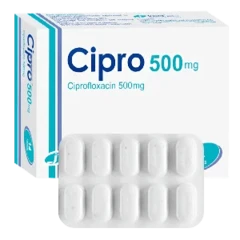
Cipro is the only ciprofloxacin product listed on this page, in 250 mg, 500 mg and 750 mg tablets for Bacterial Infections and Infectious Diarrhoea.
Key points
- The boxed warning on this fluoroquinolone reserves ciprofloxacin for patients with no alternative treatment option for chronic bronchitis exacerbation, uncomplicated cystitis and acute sinusitis, because of disabling and potentially irreversible tendon, nerve and CNS reactions.
- Ciprofloxacin inhibits the CYP1A2 enzyme, so co-administered drugs cleared mainly by that pathway reach higher plasma concentrations.
How does Ciprofloxacin work?
Ciprofloxacin is a fluoroquinolone in the Antibiotics category that blocks two enzymes bacteria need to copy their DNA: type II topoisomerase (DNA gyrase) and topoisomerase IV. Without those enzymes working, the bacterium cannot replicate, transcribe or repair its genetic material, and it dies. Resistance can build in a stepwise way through mutations in both enzyme targets.
Further reading
What is ciprofloxacin used for?
Ciprofloxacin is a fluoroquinolone antibiotic. It is used for bacterial infections, bone infections, infectious diarrhoea and typhoid fever.
How long does ciprofloxacin take to work?
Ciprofloxacin usually starts to work within 1 to 2 hours, and its effect lasts about 12 hours.
What are the side effects of ciprofloxacin?
Common side effects include nausea, vomiting and diarrhoea. Some people may also have abdominal pain, a mild rash or headache. Tendonitis, tendon rupture and peripheral neuropathy are serious and require immediate medical attention.
Can ciprofloxacin be taken with other medicines?
Ciprofloxacin can interact with tizanidine, theophylline and antacids. It inhibits the CYP1A2 enzyme, so some co-administered medicines cleared mainly by that pathway can reach higher plasma concentrations. It should not be used with tizanidine, so ask your doctor or pharmacist about your other medicines.
Who should not take ciprofloxacin?
People who are hypersensitive to fluoroquinolones or who are taking tizanidine should not take ciprofloxacin. It is reserved for patients with no alternative treatment option for exacerbations of chronic bronchitis, uncomplicated cystitis and acute sinusitis because of disabling and potentially irreversible tendon, nerve and central nervous system (CNS) reactions.
In which products can I find ciprofloxacin?
On Direct Meds, ciprofloxacin comes as Cipro. Compare their forms, strengths and packs.
How much does ciprofloxacin cost in South Africa?
Compare the rand prices for each product, strength and pack above. Prices are converted from US dollars. Larger packs usually cost less per tablet.
Payment and prices →Do I need a prescription for ciprofloxacin in South Africa?
No, not online. Direct Meds does not ask for a prescription to order ciprofloxacin. We are a broker, not a dispensing pharmacy. We arrange orders and delivery with our affiliated supplier on your behalf.
Ordering without a prescription →Where can I buy ciprofloxacin in South Africa?
On Direct Meds: choose the product, strength and pack, then check out. Our affiliated supplier delivers across South Africa. Estimated delivery is 7 days with Express Delivery, which includes online tracking, or up to 3 weeks with Regular Delivery.
How ordering works →